
Features
Agronomy
Mowers
Keep blades sharp for healthier turf and better fuel consumption
Dull blades invite disease and increase fuel consumption
August 19, 2024
By Dr. Sara Stricker and Sean Jordan
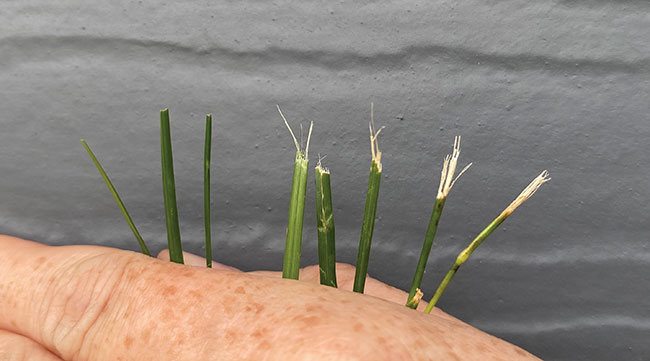 A comparison of grass cut by sharp blades, left, and by dull blades.
Photos: Guelph Turfgrass Institute
In the green industry, attention to detail can mean the difference between a healthy, vibrant turf surface and a patchy, stressed one. Among the wide selection of tools and techniques available, an often overlooked yet crucial factor is the sharpness of mowing blades. A sharp mowing blade is not just a nice-to-have; it is an essential component of effective turfgrass management.
The science behind sharp blades
When it comes to mowing, the goal is to achieve a clean cut. Sharp blades slice through grass cleanly, whereas dull blades tear and shred the grass. This isn’t ground-breaking research; the science was published by Steinegger et al back in 1983! In that study, completed at the University of Nebraska, a rotary mower was used to cut Kentucky bluegrass and the dull blade led to reduced turf quality, a straw-coloured appearance on the cut edge, and increased fuel usage. Sharp blades require less power to cut through grass, making the mower operate more efficiently. It required 22 per cent less fuel to cut the same area of grass with a sharp blade compared to a dull one!
Because sharp blades cut more effectively, they can reduce the need for multiple passes over the same area and save significant time, particularly on larger properties. Maintaining sharp mowing blades goes beyond just a cleaner cut, it also leads to reduced wear and tear on the mower. Consistently using sharp blades can prolong the life of your machine. Dull blades can cause the engine to work harder, leading to increased maintenance and potential early failure of parts.
A clean cut minimizes damage to the grass blades. Torn and shredded grass leaves are more susceptible to diseases and pests because the jagged edges provide entry points for pathogens. Clean cuts heal faster and reduce the likelihood of infection. It was hypothesized by Robert Emmons in 1995 that a dull mower blade shreds the tissues, weakening the plant and leaving a greater amount of wounded tissue for pathogen invasion. This theory was tested by Ellram et al in 2007, but they were unable to find a difference in dollar spot incidence with sharp versus dull blades. However, the theory still stands up to the test of common sense!


Grass blades are like mini solar panels. When the leaves are torn by a dull blade their surface area is reduced, hindering the plant’s ability to absorb sunlight and produce food. This can lead to stressed plants with less vigour and colour. From an aesthetic standpoint, a turf mowed with sharp blades looks uniformly green and well-manicured. In contrast, a surface mowed with dull blades can appear yellowish or brownish because of the shredded leaf tips.
It is crucial to recognize when your mowing blades need to be sharpened. Here are some telltale signs:
- Frayed grass tips: After mowing, inspect the grass tips. If they appear frayed or shredded, it is a clear indication that your blades are dull. It is important when working with stands of Kentucky bluegrass in the spring, not to mistake the stems that form during the seeding phase with leaves. These thicker parts are difficult to cut and can have a shredded and tan-tipped look even with sharp blades and reels.
- Uneven cuts: Dull blades can result in uneven cutting, where patches of grass are longer than others.
- Increased resistance: If you notice that your mower is struggling more than usual or that you need to mow the same area multiple times for an even cut, the blades are likely dull.
- Off-colour: A turfgrass surface that takes on a yellow/brown colour shortly after mowing is a sign that the grass tips are being torn rather than cleanly cut.
Blade speed and nitrogen make a difference
In a study by Pirchio et al. (2018) on tall fescue, an electric mower operating at 3,000 rpm caused more ripping and tearing damage to the grass compared to a similar electric mower running at 5,000 rpm. This shows that the higher speed of mower blades provides a cleaner cut, minimizing the damage to the grass blades. This may have also been an effect of the blade’s ability to create lift, pulling more air upward to stand the leaf blades up for a better cut. Additionally, the study found that applying 200 kg/ha (4 lb/1,000 square feet) of nitrogen fertilizer annually reduced leaf tip damage more effectively than applying 100 kg/ha (2 lb/1,000 square feet) of nitrogen. Nitrogen fertilization helps to keep the leaf tissues more turgid and less stringy, which in turn reduces leaf shredding during mowing. Thus, both the mower blade speed and the level of nitrogen fertilization play significant roles in maintaining the health and appearance of tall fescue grass by minimizing mechanical damage during mowing.


Best practices for blade maintenance
- Regular sharpening: Depending on the frequency of use, blades should be sharpened as soon as signs of dulling appear. It is difficult to put a number of hours on this as many factors contribute to dull blades and can differ from site-to-site. It is common for operations to have multiple sets of blades for each cutting unit to save downtime by being able to swap sharp blades for dull ones without having the mower out of service while sharpening. As a point of reference from the golf side, where putting green cut quality is paramount, reels may have their cutting edges touched up after only a few hours of cutting
- Proper technique: Use a file, sharpening stone, or specialized blade sharpener to hone the edges. Ensure you maintain the correct, factory-set angle. To do this when sharpening with a griding wheel, make sure the shiny metal is between the edge and the top of the blade and continue until the whole face has been ground. If using a file, keep it flat against the face the entire time so the shine is across the whole face while removing metal. Safety note: when sharpening blades wear sturdy gloves as there will be a razor-like edge formed if you do it right. If you’re unsure of how to do this, ask a professional!
- Balancing the blades: After sharpening, it is crucial to balance the blades. An unbalanced blade can cause vibrations that may damage the mower and result in uneven cuts. Use a blade balancer or even a nail on a wall to check for balance.
- Inspecting for damage: Regularly inspect blades for nicks, bends, or cracks. Damaged blades should be replaced, as they can be dangerous and ineffective.
- Cleaning the blades: After each mowing session, clean the blades to remove grass clippings, dirt, and debris. This prevents buildup and potential rust that can dull the blades as well as cause the blade to become imbalanced.
The cost of neglect
Neglecting to maintain sharp blades can have significant consequences. Inefficiency caused by dull blades can lead to higher fuel costs, more frequent mower repairs, and potentially even the need for new equipment sooner than expected. It also increases fuel consumption and emissions, contributing to a larger environmental footprint. For professionals in the lawn care industry, the appearance of the turfgrass you maintain is a direct reflection of your service quality. Dull blades can lead to unsatisfactory results, potentially costing you clients.
In the competitive field of turfgrass management and lawn care, the details matter. A sharp mowing blade is a small but crucial component of turfgrass management. Regular maintenance and proper care of your mowing blades not only benefit the grass but also contribute to the longevity of your equipment and the satisfaction of your clients. In the end, a sharp edge on your mower blades can make all the difference.
Get connected with the Guelph Turfgrass Institute by signing up to the newsletter at www.GuelphTurfgrass.ca or connecting on social media @GuelphTurf.
Cited sources:
- Ellram, A., B, Horgan, B. Hulke. 2007. Mowing strategies and dew removal to minimize dollar spot on creeping bentgrass. Crop Science 47(5): 2129–2137.
- Emmons, R. 1995. Turfgrass science and management. Delmar, Albany, NY.
- Pirchio, M., M. Fontanelli, F. Labanca, C. Frasconi, L. Martelloni, M. Raffaelli, A. Peruzzi, M. Gaetani, S. Magni, L. Caturegli, M. Volterrani, N. Gross. 2018. Comparison between different rotary mowing systems: Testing a new method to calculate turfgrass mowing quality. Agriculture 8, 152.
- Steinegger, D. H., R. C. Shearman, T. P. Riordan, E. J. Kinbacher. 1983. Mower blade sharpness effects on turf. Agronomy Journal 75(3): 479–480.
Dr. Sara Stricker is the communications and outreach co-ordinator at the Guelph Turfgrass Institute. Sean Jordan is an instructor of turf equipment for the DTM program at the University of Guelph.